 Naqood
How to File Corporate Tax in UAE with Small Business Relief (SBR): 2026 Guide
If your business is a UAE resident taxable person with revenue of AED 3 million or less in this tax period and every previous tax period, you can elect Small Business Relief (SBR) in your Corporate Tax return. Ministerial Decision No. 131 of 2026 (issued 29 July 2026) extends that AED 3 million threshold to tax periods starting on or after 1 June 2023 and ending on or before 31 December 2029. You still file a return with the Federal Tax Authority (FTA) in EmaraTax and make the election there. You are then treated as having no taxable income for that period.
SBR is not the same as the 0% band on taxable income up to AED 375,000, and it is not an exemption from filing. Qualifying Free Zone Persons and members of Multinational Enterprise Groups cannot elect SBR. Tax losses and net interest expenditure from a period where SBR is elected cannot be carried forward.
Naqood can prepare the revenue figure you enter in the return, so you spend less time assembling the numbers. Start for free.
Before you file
- Your books in Naqood are up to date for the tax period.
- Your total revenue (turnover) for the tax period, from the Profit and Loss, Trial Balance, or Corporate Tax report.
- Your Corporate Tax Registration, so you can confirm the tax period end date.
- The return is due within 9 months of the end of the tax period. If your year ends on 31 December, the due date is 30 September of the following year.
If you still need to register, start with the Corporate Tax registration guide. For the product view, see Tax in Naqood.
How to file the return in EmaraTax
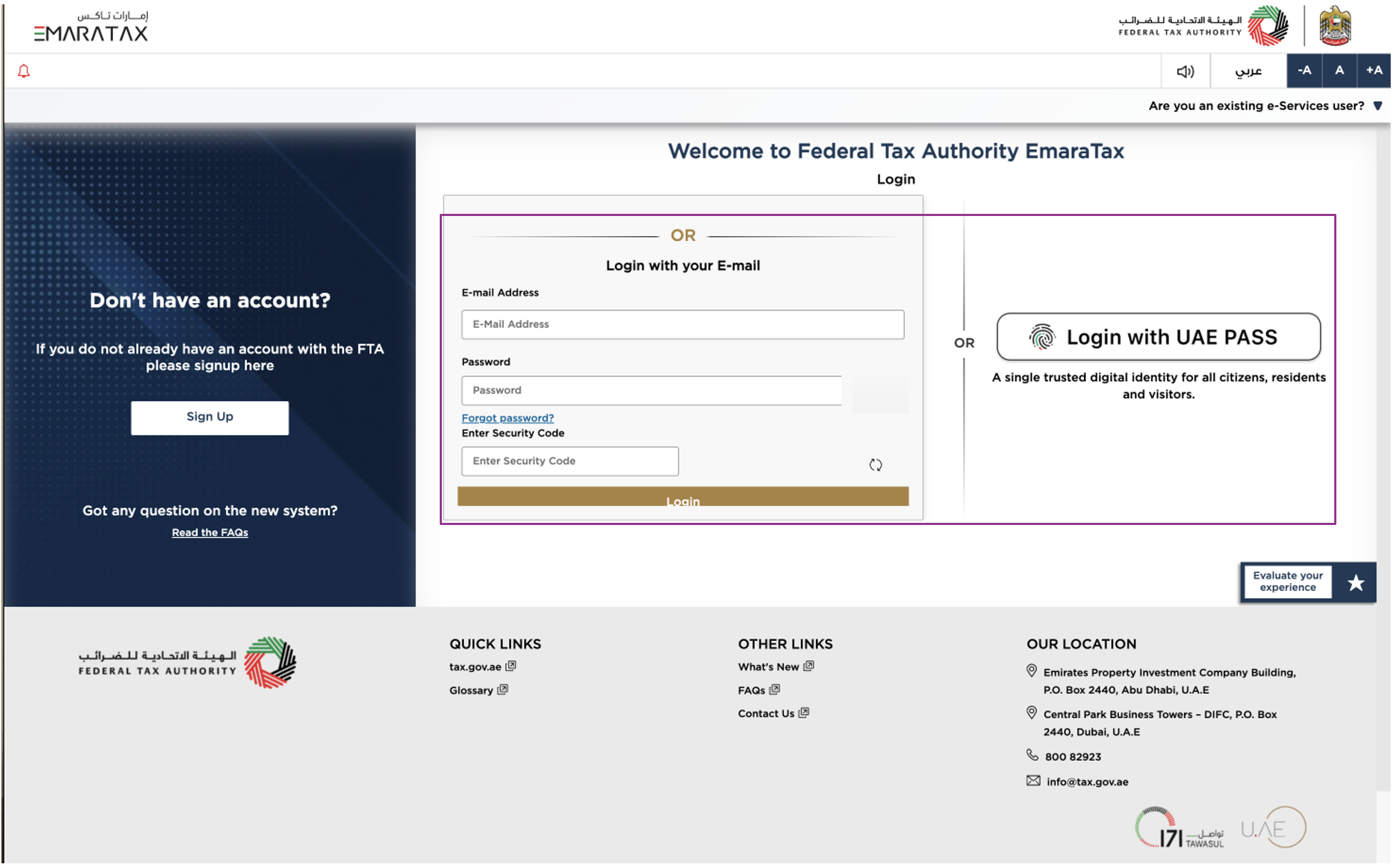
Step 1. Log in to EmaraTax
Go to EmaraTax and log in with UAE PASS or your email credentials.
Step 2. Open the Corporate Tax menu
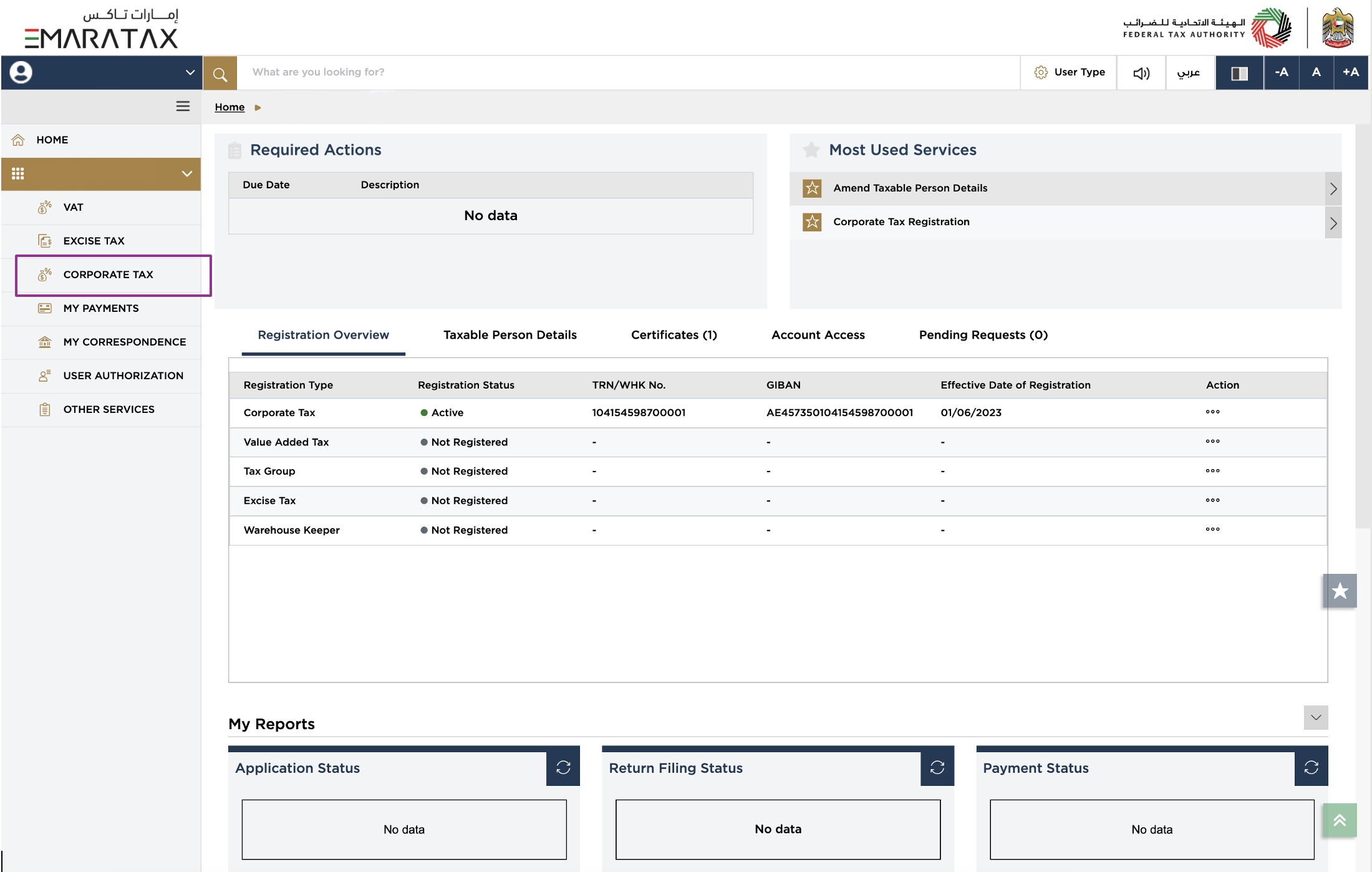
Click Corporate Tax in the left menu, then press view all.
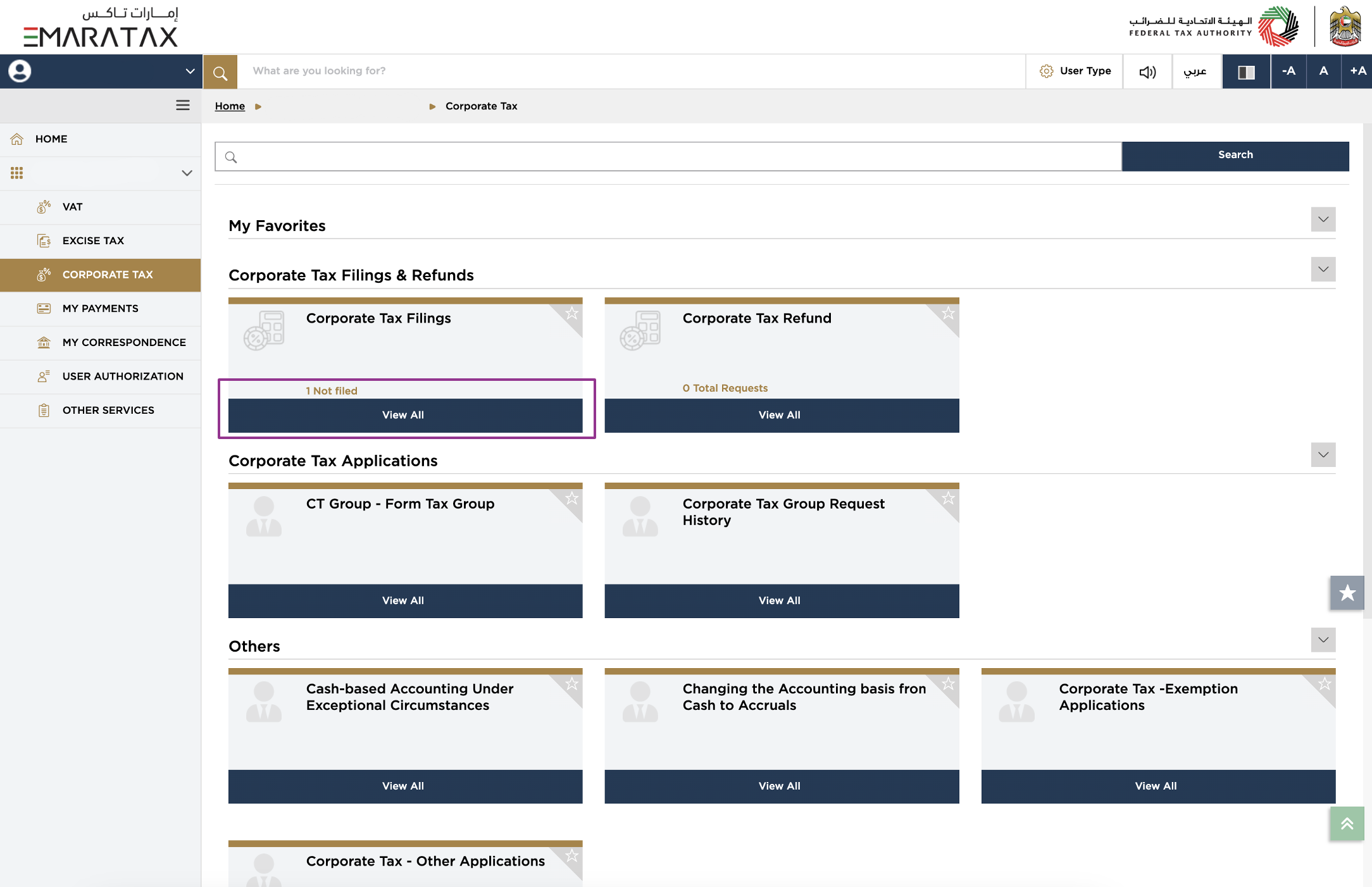
If the filing action does not appear, your tax period may not have ended yet, or the FTA may not have opened the return. Check the tax period on your Corporate Tax Registration and wait until the period has closed.
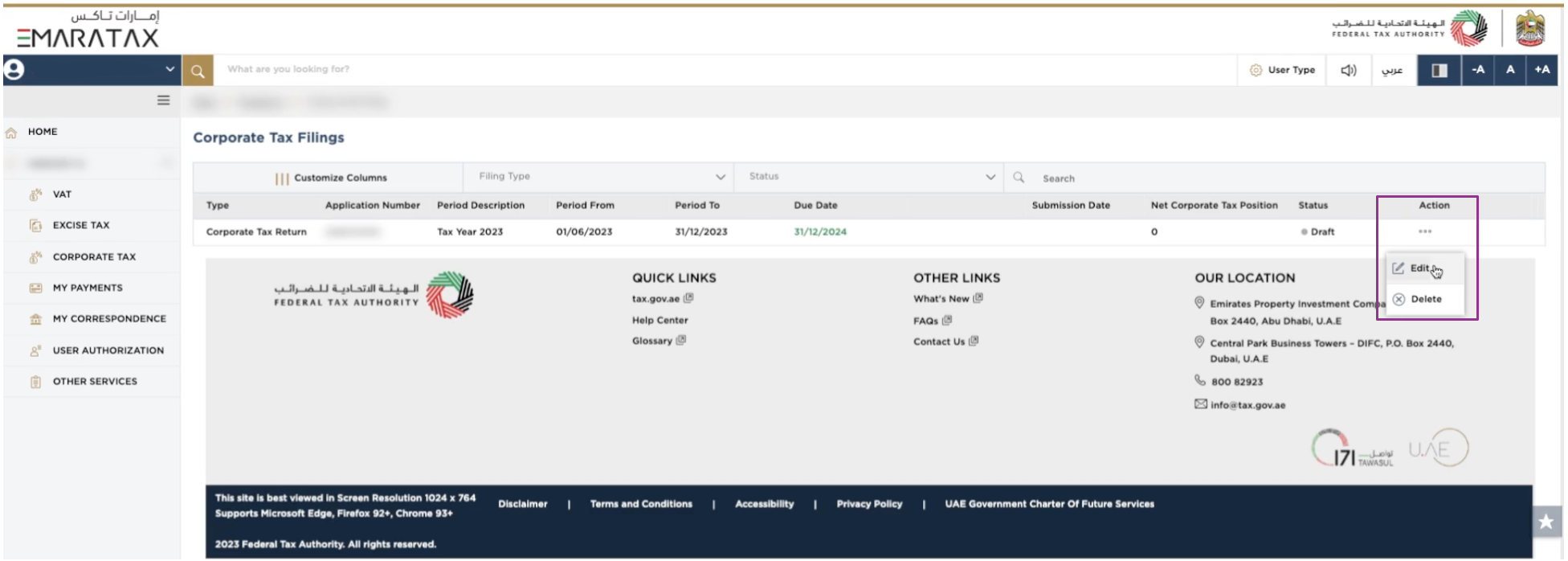
Step 3. Start the Corporate Tax filing
Click the menu under the Action column and select Edit.
Step 4. Check your taxpayer details
Confirm that your TRN, name, address, email, and phone number are correct.


Is the above information correct?
- Choose Yes if the details are correct.
- Choose No if you need to amend them.
Step 5. Taxable person information
Is the Taxable Person a partner in one or more unincorporated partnerships?
Most companies answer No. Choose Yes only if the taxable person is actually a partner in an unincorporated partnership.
Is the Tax Return being completed by a Government Entity, Government Controlled Entity, Extractive Business, or Non-Extractive Natural Resource Business?
Most private businesses answer No. Choose Yes only if one of those categories applies.
What is the Taxable Person’s Revenue derived during the Tax Period (AED)?
Enter total turnover for the tax period, not profit. In Naqood you can find this in three reports:
- Trial Balance
- Profit and Loss
- Corporate Tax
Have the Taxable Person’s Financial Statements been prepared under the cash or accrual basis?
- Choose Cash if revenue and expenses are recognized when cash is received or paid.
- Choose Accrual if revenue and expenses are recognized when earned or incurred.
If you are unsure, read the cash basis or accrual basis guide.
Does the Taxable Person conduct more than one Business or Business Activity?
Choose Yes if you operate more than one business or activity, then use Actions, Edit, to enter the estimated percentage of total revenue for each sector. Choose No if you have only one.
Is the Taxable Person a member of a Multinational Enterprise Group?
Choose Yes only if you are a member of a Multinational Enterprise Group. Most small UAE companies answer No. Members of those groups cannot elect SBR.
Is the Taxable Person tax resident in a foreign jurisdiction under an applicable Double Taxation Agreement?
Choose Yes only if the taxable person has been recognized as tax resident in a foreign jurisdiction under a double tax agreement. Most UAE companies that are not a foreign branch answer No. If you are unsure, speak to an FTA-approved accountant.
Step 6. Free Zone questions
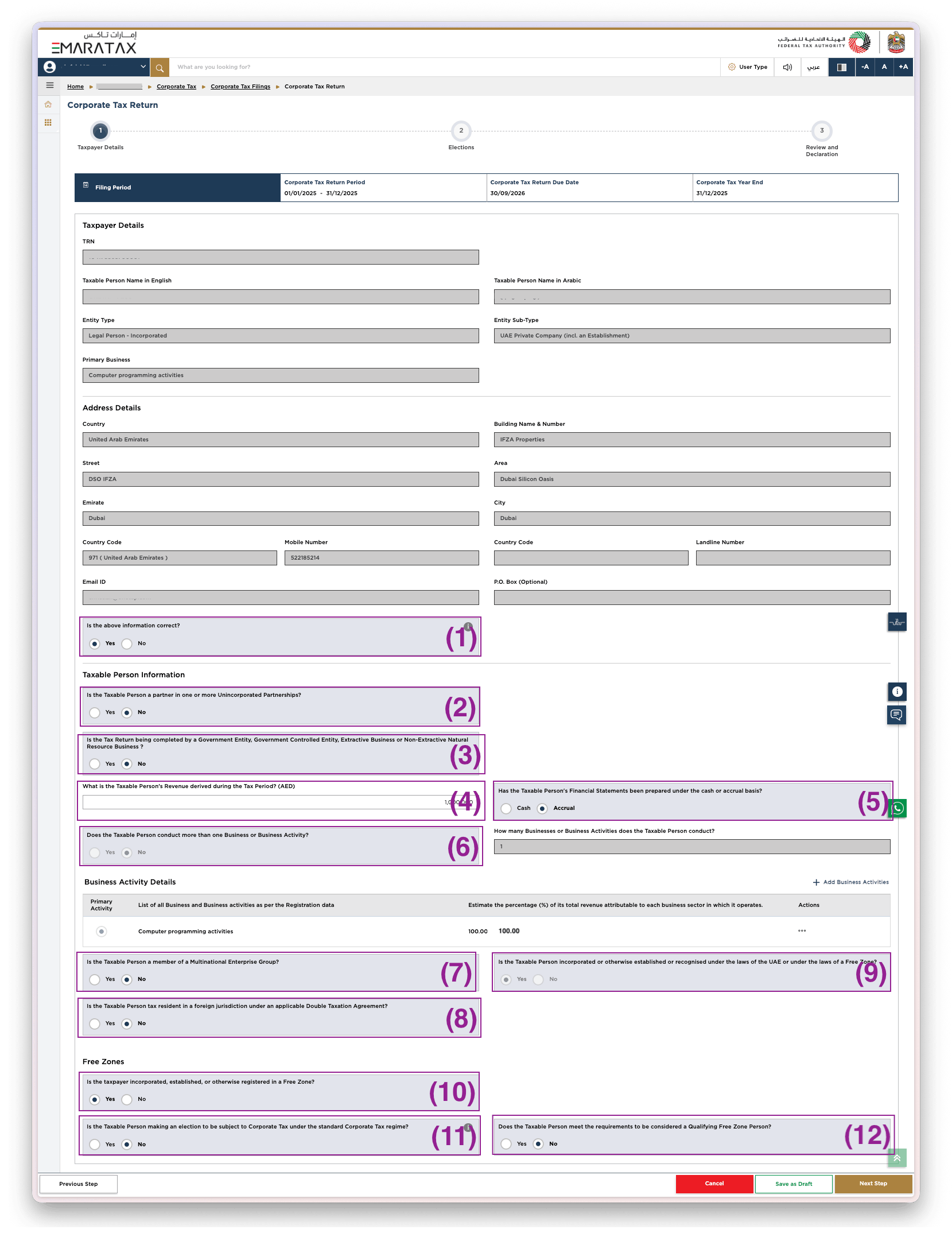
Is the Taxable Person incorporated or otherwise established or recognized under the laws of the UAE or under the laws of a Free Zone?
This follows your company details. Change it only if you first amend your taxpayer details.
Is the taxpayer incorporated, established, or otherwise registered in a Free Zone?
This is usually pre-filled from your earlier details.
Is the Taxable Person making an election to be subject to Corporate Tax under the standard Corporate Tax regime?
This is mainly a Free Zone choice. Mainland businesses normally answer No. Choose Yes only if you want to be subject to the standard Corporate Tax regime.
Does the Taxable Person meet the requirements to be considered a Qualifying Free Zone Person?
Choose Yes only if you meet the Qualifying Free Zone Person (QFZP) conditions. Most mainland businesses answer No. If you may qualify, read the Qualifying Free Zones guide. A QFZP cannot elect SBR.
Has the Taxable Person made an election, in any of the preceding 4 tax periods, not to be subject to Corporate Tax at the rate applicable to Qualifying Free Zone Persons?
Choose Yes only if you previously elected out of the QFZP rate. Otherwise choose No.
Step 7. Other elections
You may also be asked about the realisation basis, whether you are a bank or insurance provider, and transitional rules for qualifying immovable property, intangible assets, or financial assets and liabilities owned before the first tax period. Choose Yes only when that election actually applies to you. Most small businesses claiming SBR answer No to these elections.
If you are unsure, get advice before you submit. These choices can affect later periods.
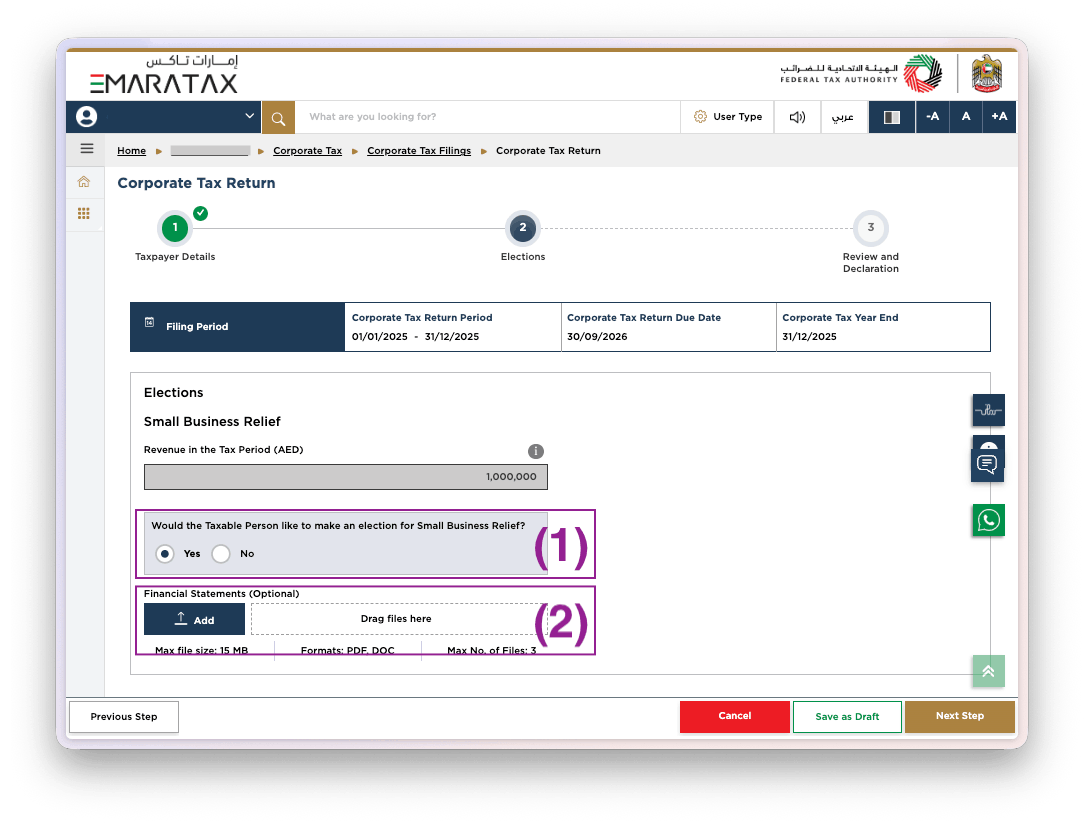
Step 8. Elect Small Business Relief
The revenue figure you entered earlier is used to assess whether you meet the AED 3 million test.
Would the Taxable Person like to make an election for Small Business Relief?
- Choose Yes if you meet the conditions and want to elect SBR for this tax period.
- Choose No if you do not want to elect it, or if you know you do not qualify.
Read the rules in more detail on Small Business Relief.
You can optionally attach financial statements. These can be downloaded from Naqood.
Step 9. Review and submit
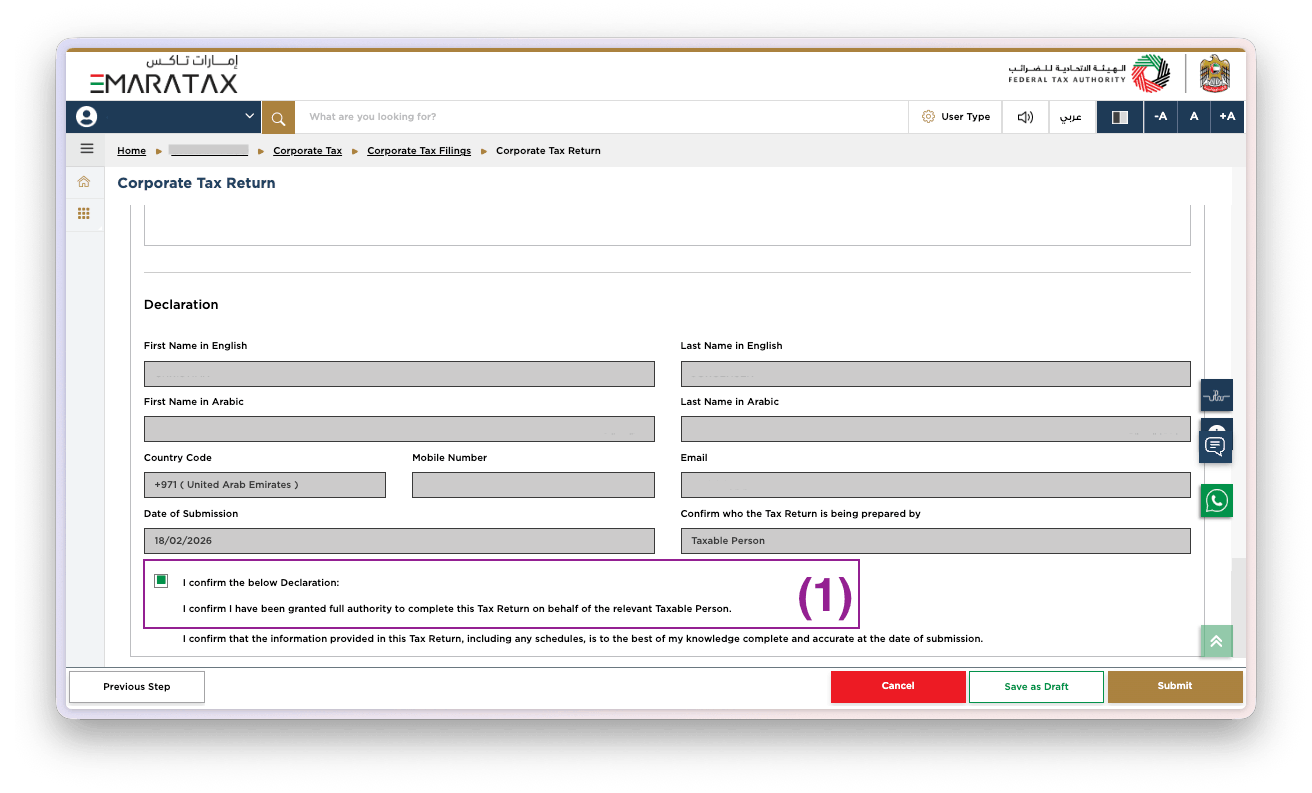
Tick the declaration that the information is, to the best of your knowledge, true and complete, then submit the return.
After you submit, keep the records that support your revenue figure and the SBR election. For a wider view of the return itself, see the Corporate Tax return guide.
Frequently asked questions
Who needs to file Corporate Tax in the UAE?
UAE resident taxable persons, and other persons required to file under the Corporate Tax Law, generally must file a return even if no tax is due. SBR does not remove that filing duty. If you are registered for Corporate Tax, plan to file within 9 months of the period end.
What is the Corporate Tax rate in the UAE?
Under the standard regime, taxable income is charged at 0% up to AED 375,000 and at 9% above that amount. SBR is different: if you elect it and meet the conditions, you are treated as having no taxable income for that tax period.
What is the deadline for filing Corporate Tax in the UAE?
The return is due within 9 months of the end of the tax period. If the period ends on 31 December, the deadline is 30 September of the following year.
How do I file Corporate Tax in the UAE?
Log in to EmaraTax, open Corporate Tax, edit the return, enter your details and revenue, make any elections (including SBR, if you qualify), then review and submit. The step-by-step instructions above walk through each screen.
What documents are required for Corporate Tax filing in the UAE?
Have your trade licence, Corporate Tax Registration (TRN), and financial statements ready. A Profit and Loss, balance sheet, and tax or revenue report from Naqood will cover the figures most businesses need to enter.
What happens if I miss the Corporate Tax filing deadline?
The FTA may impose penalties for late filing or late payment. File before the deadline, and if you have already missed it, submit the return as soon as you can and take advice on the next step.
Can Free Zone companies use the 0% Corporate Tax rate?
A Free Zone business that meets the Qualifying Free Zone Person conditions may be eligible for the 0% rate on qualifying income. That is a different regime from SBR, and a QFZP cannot elect SBR. See the Qualifying Free Zones guide for the conditions.
What is Small Business Relief, and how do I apply for it?
SBR is available to a UAE resident taxable person with revenue of AED 3 million or less in the tax period and every previous tax period, for tax periods ending on or before 31 December 2029. Elect it in the Corporate Tax return by answering Yes to the SBR question. You still must file. More detail is on the Small Business Relief page.
Can I amend a Corporate Tax return after submission?
Yes. You can request an amendment in EmaraTax if you find an error after filing. If the error led to tax being underpaid, penalties may apply.
How can I get help with Corporate Tax filing in the UAE?
If you want help checking eligibility or completing the return, you can consult an FTA-approved accountant.
File VAT and Corporate Tax with FTA accredited software
Naqood prepares your VAT return and Corporate Tax figures from your invoices and bills, so filing takes less manual work. Start free, FTA accredited.